
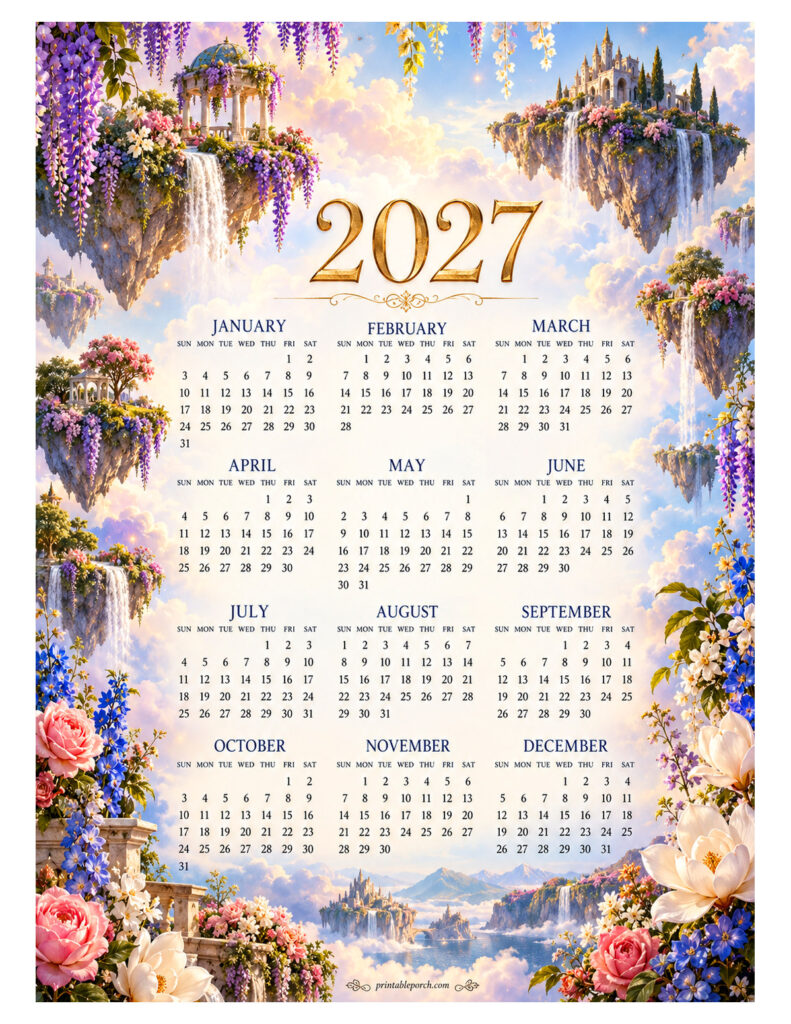
 18 free designs below
By: Printable Porch Team
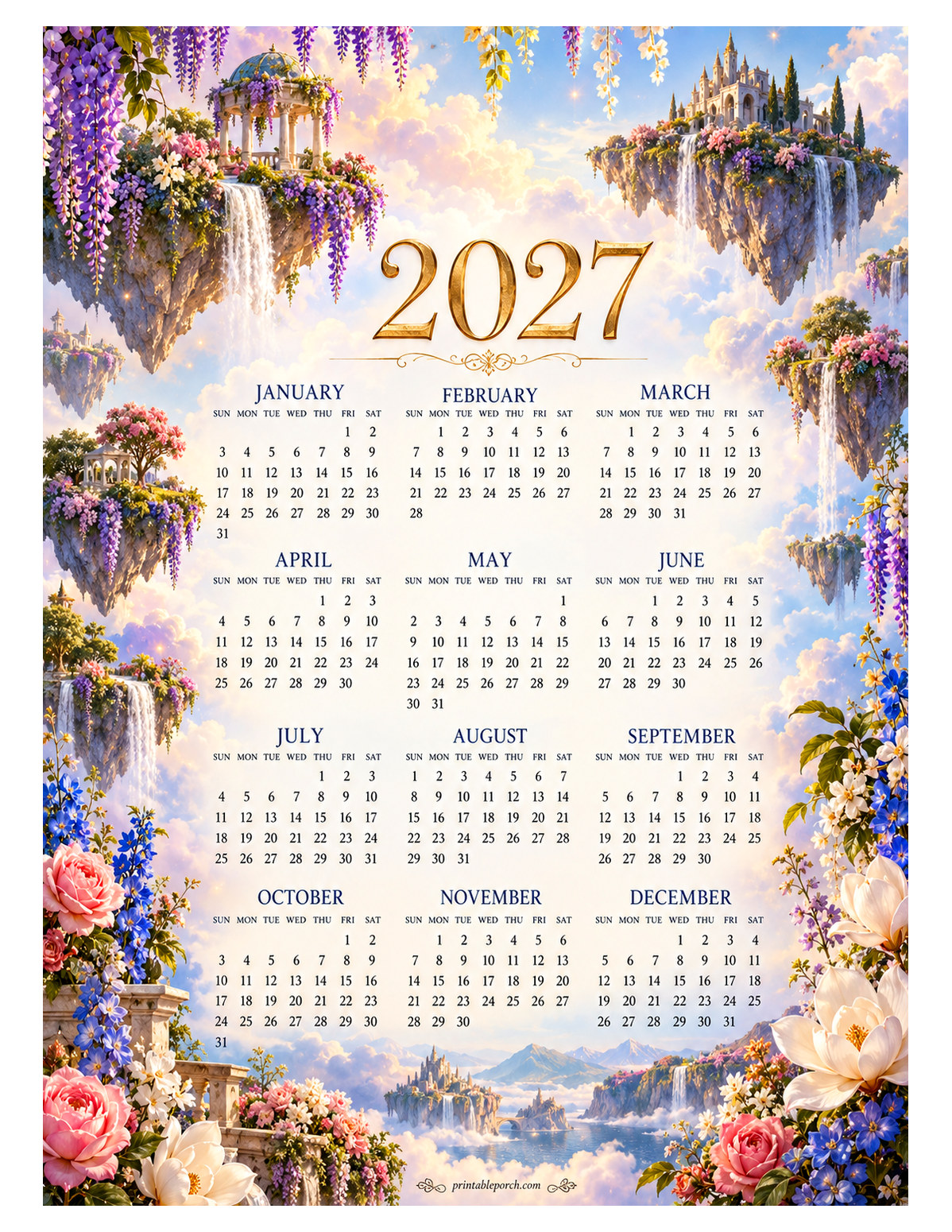
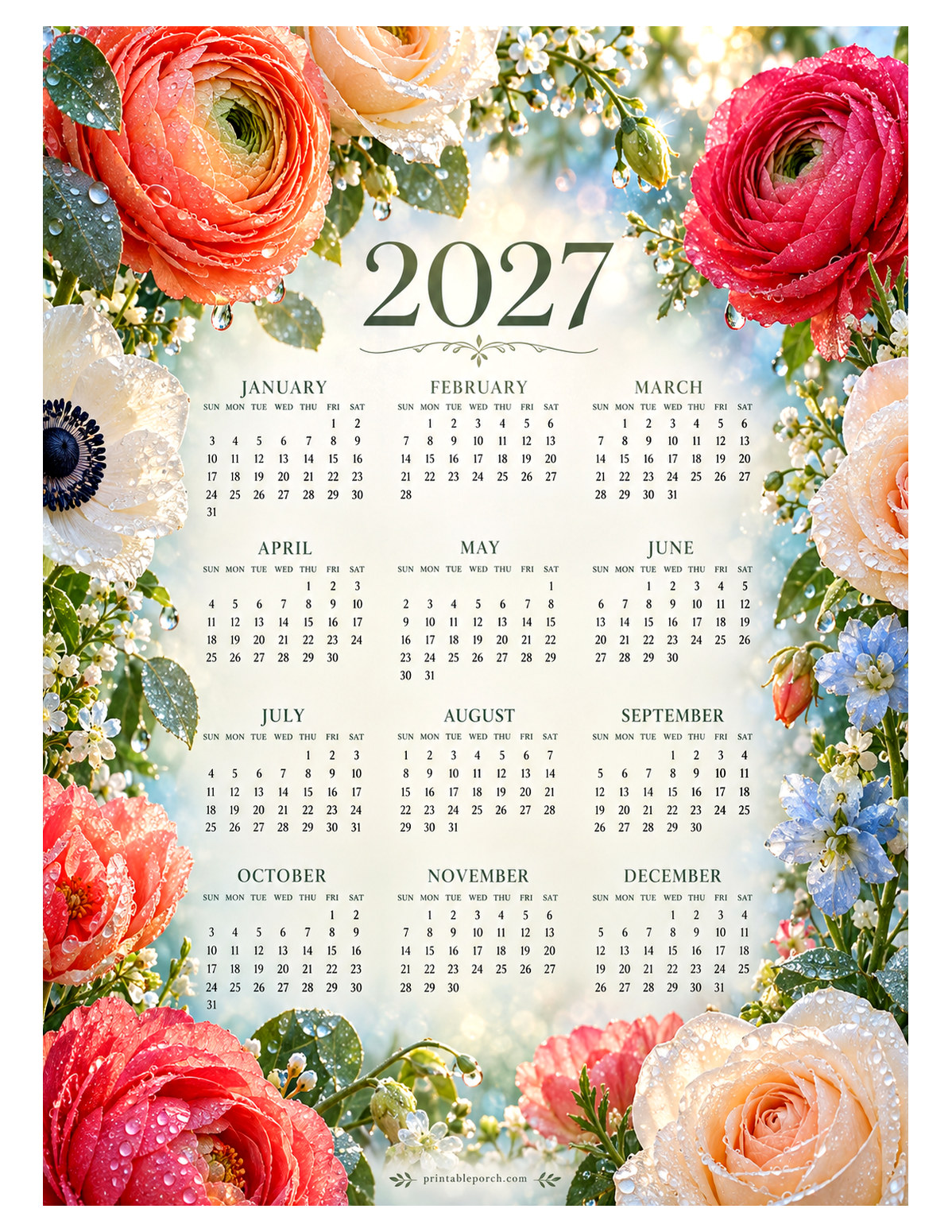
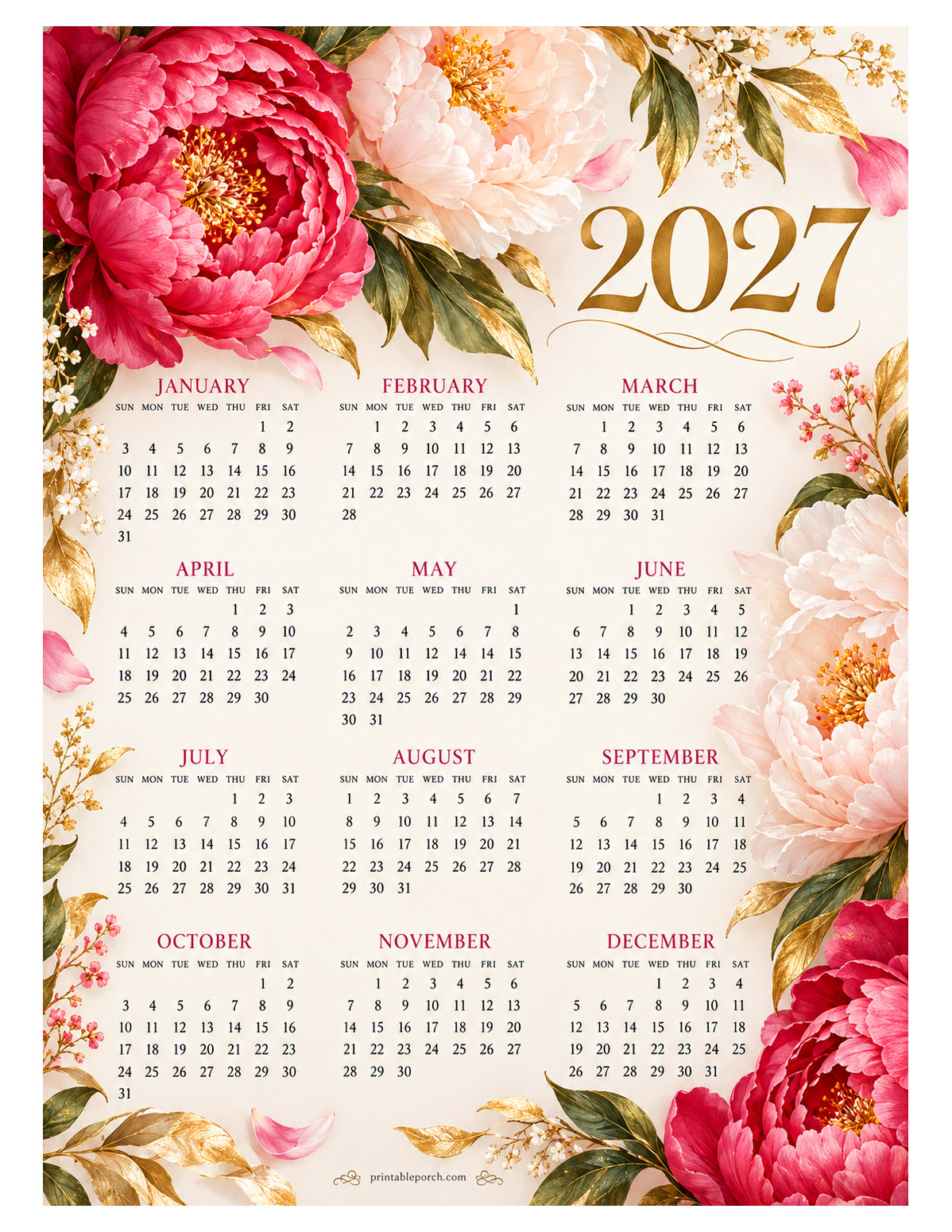
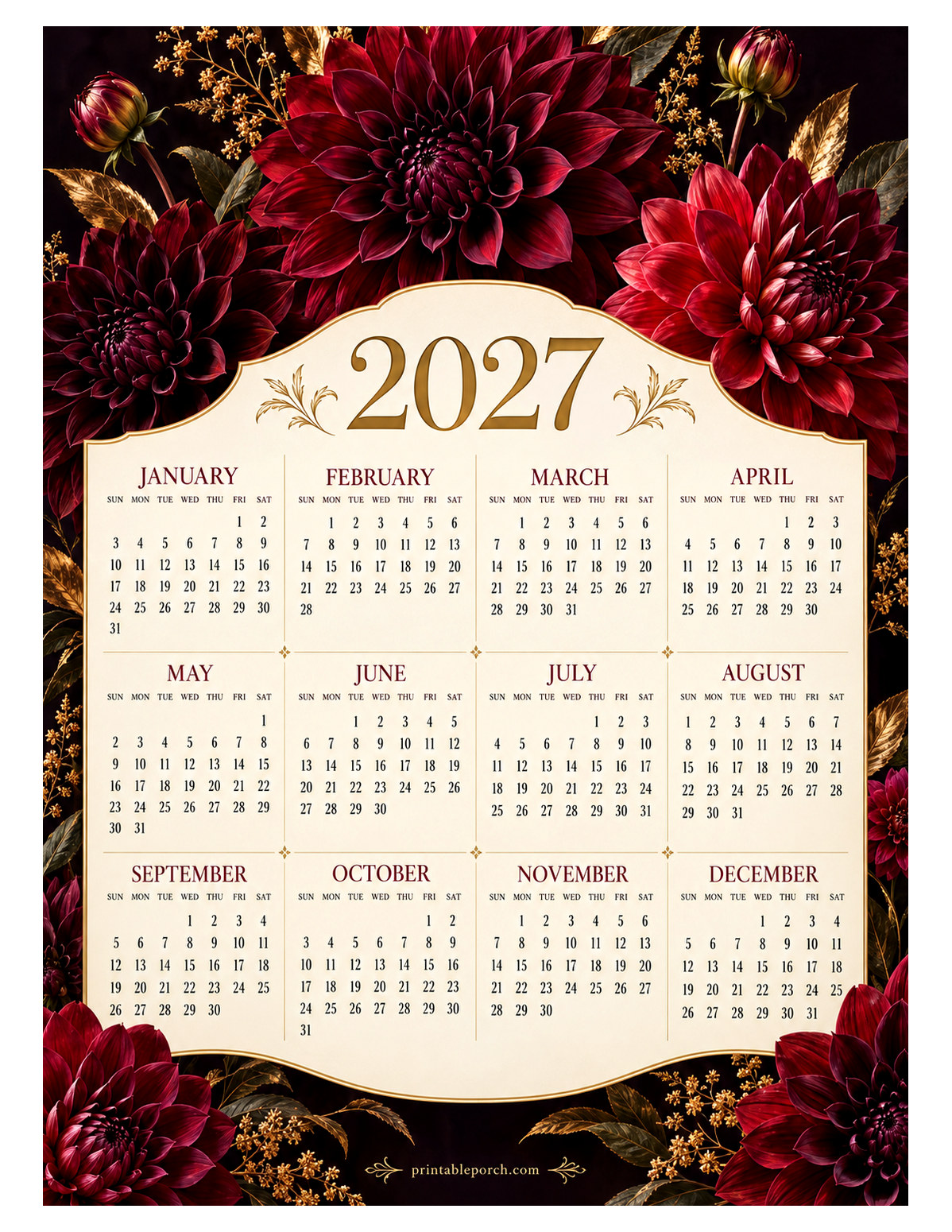
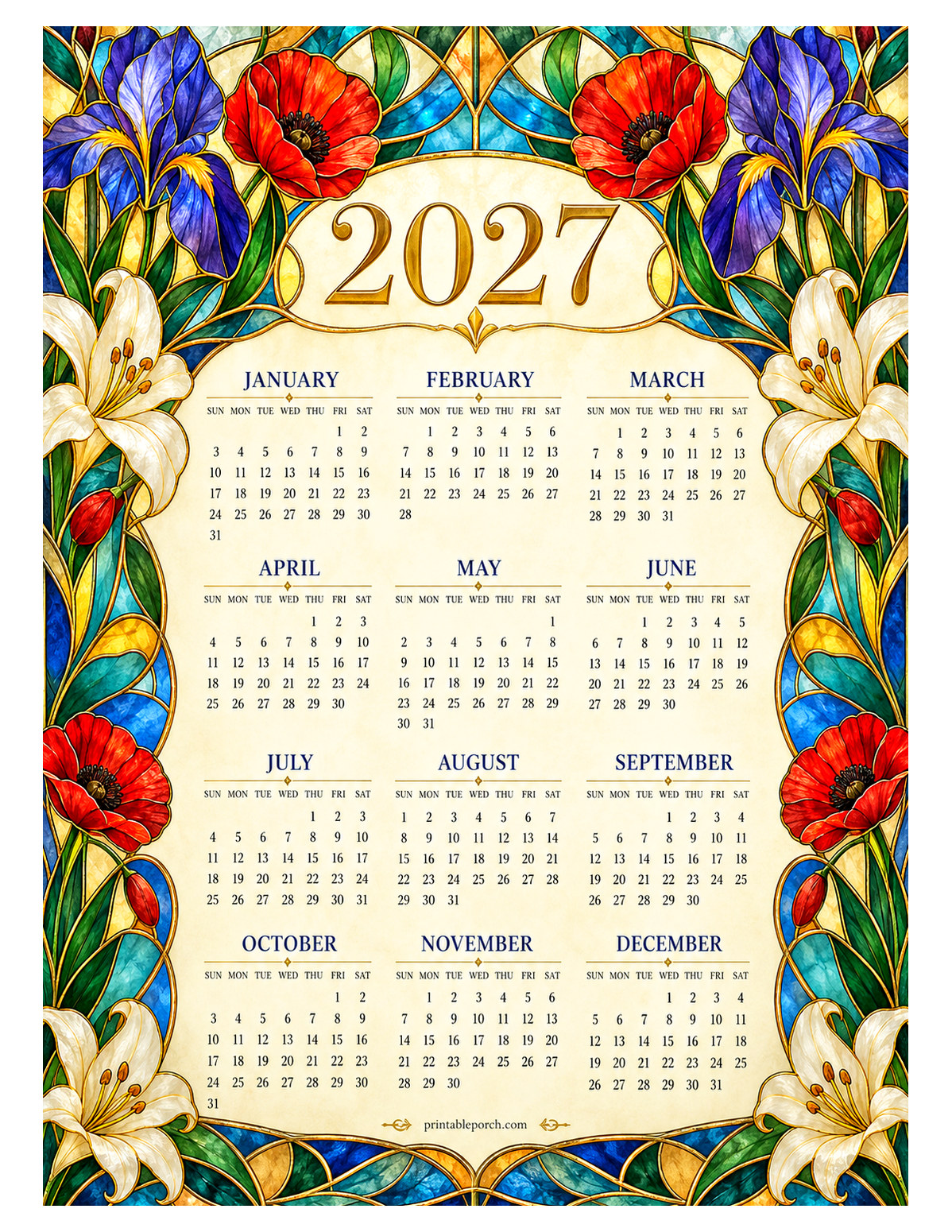
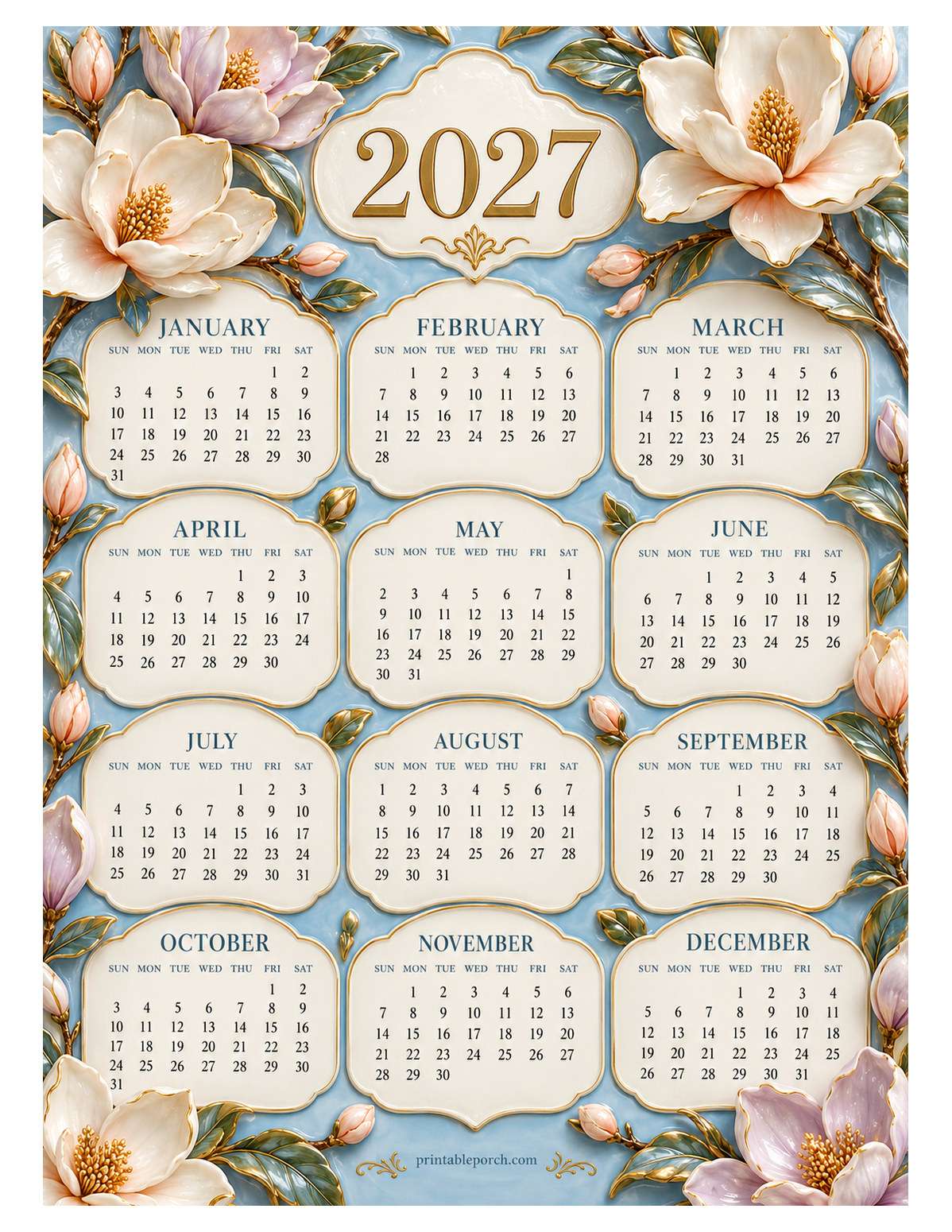
A flower calendar is the simplest way to keep a garden on the wall all year, even in January. This page collects free printable flower calendars for 2027: one-page yearly sheets with all twelve months on a single US Letter page, framed by peonies, roses, poppies, magnolias, orchids, lilies, wisteria and wildflowers. The styles range from soft watercolor and morning dew photography to gilded Art Deco panels, stained glass, folded paper flowers and a dark Dutch still life, so there is a sheet for a kitchen, a bedroom, an office desk or a classroom wall.
Every calendar here is free to print at home. Each sheet is designed for standard 8.5 x 11 inch paper, starts the week on Sunday, and has been checked so that every month begins on the right day and has the right number of days. Print one for the fridge, frame one for a gift, or tuck one into the front of a planner. New flower designs are added regularly, so the page grows over the year.
Flower Yearly Calendars 2027
Eighteen one-page flower calendars for the whole of 2027, each in its own style: soft watercolor gardens, gilded peonies, stained glass poppies, paper flowers, crystal blooms and a Dutch still life. Every sheet is US Letter size and prints at home on ordinary paper. Click Print for a quick copy or Download PDF for a crisp file you can keep and print again.


How to Print Your Flower Printables
Every sheet on this page is free for personal use. Click Download PDF for a print-ready file sized for US Letter (A4 works too - choose "Fit to page" in the print dialog), or Print to send the sheet straight to your printer. Plain paper is fine for a desk or a fridge; a heavier 28 lb / 110 gsm sheet stays flat on a wall and takes color better.
The monthly calendars come in matching sets of twelve, so you can print the whole year at once with Full 2027 Year PDF, punch two holes along the top and hang the stack on binder rings - or take it to a copy center for spiral binding. New Flower printables are added to this same page, so bookmark it and check back.
About the Flower Calendar
Why flowers and calendars belong together
Flowers were the first calendar people ever had. Long before printed dates, the order of blooms told the year: snowdrops meant the worst of winter was over, apple blossom meant it was safe to plant, roses meant midsummer, and the last chrysanthemums meant the frost was near. Farmers, monks and herbalists all kept "flower clocks" in their heads, and in the eighteenth century Carl Linnaeus even proposed a real one, a garden bed planted so that different flowers opened and closed at different hours of the day. A flower calendar on the wall keeps a little of that old rhythm in a modern room.
Birth month flowers
Every month has a traditional flower, and many people choose a calendar sheet by the bloom of their own month or the month of someone they love. January belongs to the carnation and the snowdrop. February has the violet and the primrose. March is the daffodil, April the daisy and sweet pea, May the lily of the valley and hawthorn, June the rose and honeysuckle. July carries the larkspur and water lily, August the gladiolus and poppy, September the aster and morning glory, October the marigold and cosmos, November the chrysanthemum, and December the holly and narcissus. A yearly calendar that shows roses, poppies, cosmos and lilies together is, in its way, a whole year of birth flowers on one page.
The language of flowers
In the Victorian era a bouquet could carry a message that words were not allowed to say, and printed dictionaries of "floriography" sold in the thousands. Red roses meant love, of course, but a yellow rose meant friendship or jealousy depending on the book, a peony stood for good fortune and a happy marriage, a magnolia for dignity and perseverance, a red poppy for remembrance, an orchid for rare beauty and a camellia for admiration. Dahlias spoke of elegance and inner strength, wisteria of welcome, the iris of wisdom and hope, and the hellebore, which blooms in the snow, of serenity through hard times. Hanging a flower calendar that features a particular bloom is a quiet way of keeping that meaning in view for twelve months.
A short history of the flower calendar
Printed calendars with flower borders go back to the illuminated books of hours of the fifteenth century, where each month was framed with the plants in season. In the nineteenth century, cheap color lithography turned the flower calendar into a household object: seed companies, insurance agents and pharmacies gave them away by the millions, and the free promotional calendar with a floral border became one of the most widely seen pieces of printed art in America. Botanical illustrators like Pierre-Joseph Redoute and, later, the painters of the Art Nouveau and Art Deco movements set the styles that still shape flower calendars today, from soft watercolor roses to bold geometric panels with lilies and orchids. The sheets on this page borrow from all of those traditions.
How to choose a style
A pale watercolor or morning dew sheet suits a bright kitchen or a bedroom with light walls. Gilded peonies, velvet dahlias, emerald lilies and the Dutch still life are made for darker rooms, wood furniture and a frame with a mat. Stained glass and Art Deco designs work well in an office or a hallway where a strong pattern is welcome. Paper flowers and crystal blooms are favorites for a child's room, a craft corner or a classroom. If you cannot decide, print two: one on the wall and one folded into a planner.
Printing tips
For a wall calendar, use bright white cardstock of 65 to 80 lb (about 180 to 220 gsm); ordinary copy paper works for a planner insert or a fridge sheet. Print from the PDF rather than the image so the colors and the fine calendar lines stay sharp. Set the printer to its "photo" or "best" quality mode and choose "fit to page" only if your printer cannot print close to the edge. Let inkjet prints dry for a few minutes before handling. A simple black or thin gold frame with a white mat turns any of these sheets into a print that looks far more expensive than the paper it is printed on.
Little facts about the flowers on these sheets
The peony has been cultivated in China for more than 1,500 years and is still called the "king of flowers" there. Wisteria vines can live for over a century; one in Sierra Madre, California is more than a hundred years old and covers about an acre. Poppies can lie dormant in the soil for decades and bloom only when the ground is disturbed, which is why they covered the fields of Flanders after the First World War. Orchids are the largest family of flowering plants, with more species than there are kinds of birds and mammals put together. Magnolias are so old that they evolved before bees existed and were pollinated by beetles. Dahlias are the national flower of Mexico, and the tubers were once grown as food. Hellebores, sometimes called Christmas roses, bloom while there is still snow on the ground. Camellias gave the world both the flower and tea, since the tea plant is a camellia too.